
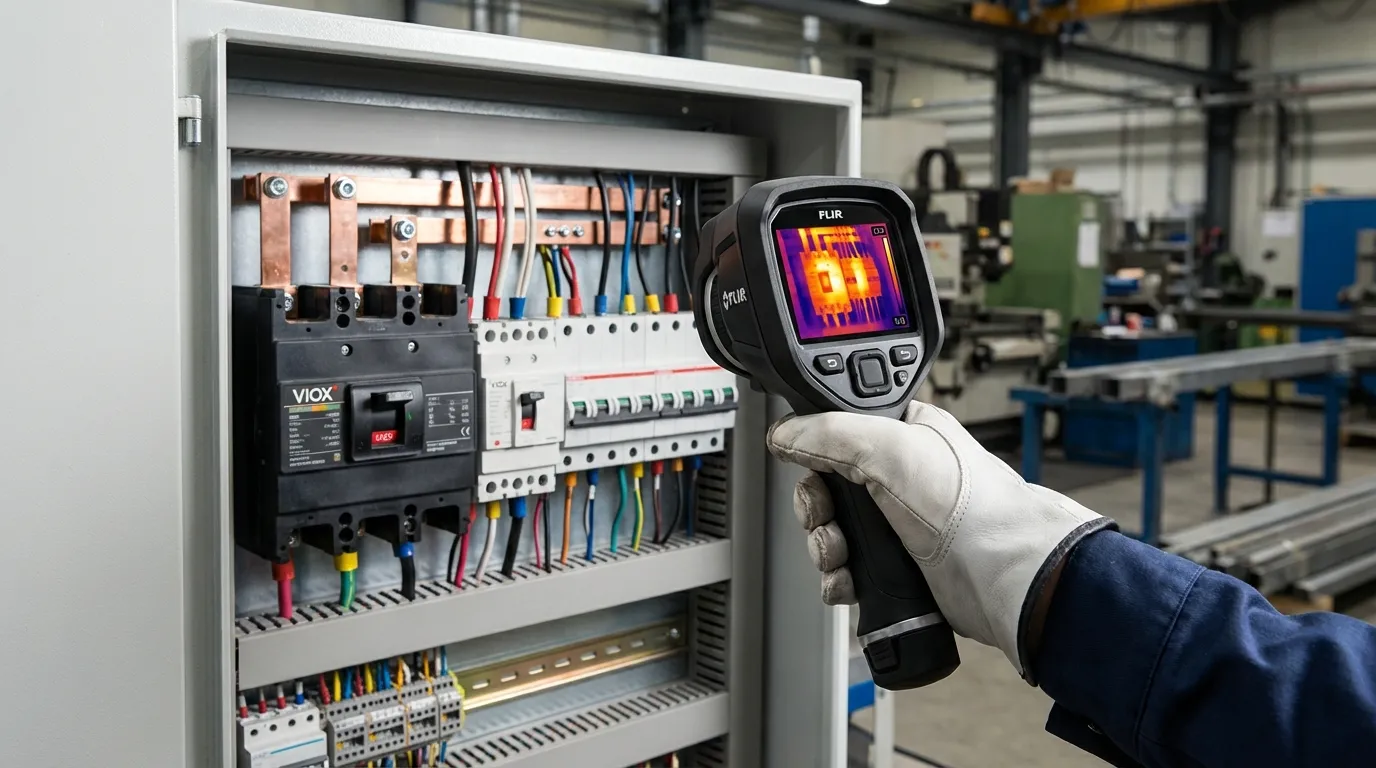
A contractor once sent us a cross-reference that was, on every electrical field, perfect. Same continuous current, same voltage class, same trip characteristic, same pole count, same module width. The part went into a distribution board in a commercial fit-out, and the work was signed off by the electrician who did it.
Six weeks later the inspector failed the entire board. The replacement was IEC 60947-2 tested. The board required UL 489 listed devices. Nothing about the part was wrong except the one field nobody had compared.
Why the confusion happens
Both standards describe circuit breakers. Both specify short-circuit performance. Both produce a document with an interrupting rating printed on it in kiloamps. Read them side by side at a glance and they appear to be regional editions of the same idea — one American, one international.
They are not. They are built around different assumptions about what happens after the breaker clears a fault, and that difference is the whole reason an inspector cares which one you used.
A part number that reads alike can carry half the fault current. A listing that reads alike can carry none of the approval.
Two different tests
The short version is that UL 489 assumes the breaker will stay in service after clearing a fault, and IEC 60947-2 does not necessarily assume that.
UL 489, briefly
A UL 489 listed breaker is tested to clear its rated fault current and remain serviceable. After the test sequence the device must still perform: it must carry its rated current, it must trip again at the right point, and the enclosure must not have failed. The listing is granted for a specific device in a specific application class, which is why you will sometimes see the same physical breaker listed for one use and not another.
IEC 60947-2, briefly
IEC 60947-2 defines two service categories. A breaker can be rated for Icu, its ultimate breaking capacity, and separately for Ics, its service breaking capacity. Ics is often a fraction of Icu — 50% and 75% are both common. A device can legitimately advertise a high Icu while being expected to be replaced after clearing a fault near that figure.
The practical consequence
An IEC device with an Icu of 10kA is not equivalent to a UL 489 device with a 10kA interrupting rating, because the two figures are answering different questions. One is "what can it survive once", the other is closer to "what can it survive and carry on".
Side by side
Scope — UL 489: Branch-circuit and feeder protection; IEC 60947-2: Circuit breakers generally, incl. equipment protection
Fault rating published as — UL 489: Interrupting rating (kA); IEC 60947-2: Icu and Ics (kA)
Serviceable after rated fault — UL 489: Required; IEC 60947-2: Only at Ics, which may be 50–75% of Icu
Calibration reference — UL 489: 40°C, in the intended enclosure; IEC 60947-2: Typically 40°C, free air unless stated
Accepted for branch protection in a UL panel — UL 489: Yes; IEC 60947-2: No, unless separately UL 489 listed
Accepted under IEC installation rules — UL 489: Depends on local adoption; IEC 60947-2: Yes
Simplified for comparison. Always read the specific device listing rather than the standard in general — application class and enclosure conditions both narrow it further.
What it costs when it goes wrong
The failure mode here is unusually expensive, for three reasons.
It is invisible at install. The part fits, energises and functions. Nothing about the commissioning test reveals a listing mismatch.
It is found late. Typically at inspection or at insurance review, by which point the board is closed, the ceiling is on, and the tenant has moved in.
It fails the assembly, not the part. One non-listed device in a panel can put the approval of the whole board in question, not just that way.
Watch for rebadged devices
A device sold into several regions may carry both marks, one mark, or a mark for a different variant in the same family. The family datasheet is not the device listing. Check the specific catalogue number.
How to check in thirty seconds
Three questions, in this order. If any answer is unclear, stop and ask the supplier for the listing document rather than the marketing sheet.
What does the panel require? A UL-listed assembly requires UL 489 listed branch devices. This is a property of the board, not the breaker.
What is the device actually listed to? Not the family — the exact catalogue number, in the exact configuration, for the intended application class.
If the figures differ, which figure is quoted? An Icu of 10kA compared against a UL interrupting rating of 10kA is not a like-for-like comparison.
Never infer a listing
Of everything in a specification, listing is the field we will never estimate from a part-family pattern. If a manufacturer has not published it for that catalogue number, we mark it as not published and the comparison flags it in red. A guess here is worse than a blank.
The honest exceptions
There are devices listed to both standards, and there are plenty of installations where an IEC device is entirely correct — equipment protection inside machinery built to IEC rules, for one. The point is not that one standard is better. It is that they are not substitutes for each other, and the substitution is easy to make by accident because every other field on the datasheet lines up.
This is why certification sits as its own stage in our matching pipeline rather than as a row in the spec table. Rating and geometry can be negotiated with engineering judgement. A listing mismatch is closer to a hard stop, and it deserves to be visible before anyone scrolls.
If you are cross-referencing something now and the listing row is the one giving you doubt, send us the part number — we will pull the archived sheet and tell you what it actually says.